
All That Rope
“What are you going to do with all that rope?”
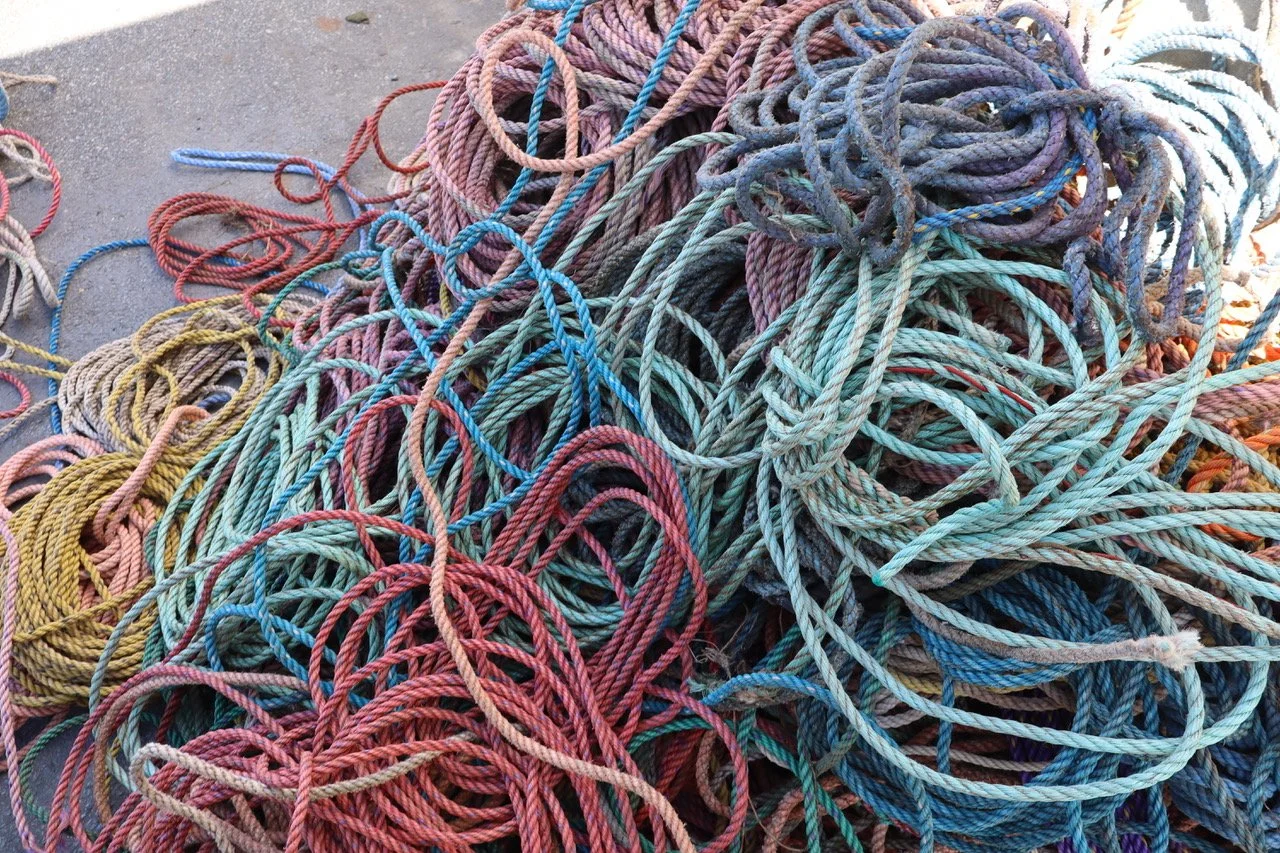
No answer to any question about life and work on an island is simple. Too many variables are maddeningly interconnected. You start out answering an inquiry about school vacation and in no time you’re rattling on about the marine forecast, and who’s got a boat on the mooring, and where you go to get a diesel engine repaired.
This is the reticulum of island factoids, the network of occupational trivia, the mesh of history. I could write a 900-page book that would include everything you can think of about daily life here simply by answering that question about our big pile of rope, and letting one topic naturally lead into another, as they do. Of course, nobody would read a 900-page book, so the editors would have to throw water a little.
I’ve tried to answer that question before. I start in about island logistics and trucks and boats and going to the dump and then somebody from inland stops me with, “Hold on--whaddya mean, ‘pot warp’?”
Matinicus Island is a lobster fishing community, and lobster harvesters generate a large quantity of unwanted plastic rope by way of routine gear maintenance. Lobster trap rope is generally called “pot warp” even by fishermen who do not refer to lobster traps as “pots.” Relatively new old pot warp, so-called, might potentially be usable for other things, but much of what we have to dispose of is rotten and useless. For the lack of a place to put it, three or four generations of lobsterman’s discarded rope, hundreds of thousands of miles of it, is knocking around underfoot all over the Maine coast.
Here, we have a big pile. It beats tossing it overboard.
A conversation such as this will reliably end up detailing the Maine lobster industry-- history, heritage, the stinky grunt work and the pleasure of boat ownership. Next thing you know, we’re talking about living with the ocean, the romance, scenery, the danger, and the courage. Rescues at sea. How everybody offshore is a first responder. Trips I shouldn’t have made in boats unfit for the crossing, local heroes, storms, beachcombing. Flying over the bay and taking that view for granted, while others save up all year to look at it. Fog; so much fog…
There we are now, talking about the weather. Always. The marine and aviation forecasting sites, “the wind at the Rock,” the teeth of the gale. Weather forecasting before computers. Old guys who knew things. Mariners, bush pilots, and reckoning the next day’s chances by nothing more than the direction of the wind.
Weather is a huge part of the art and craft of aviation, and soon we’re going on about the history of our flying service, starting with Arthur Harjula and Herb Jones 50 or 60 years ago. Then: any other transportation, the old days of mailboats, the Island Transporter.
Transportation connects our chat to the topic of leaving an island, for any reason, which is a big subject. Routine shopping is hard enough. Hobbies, relatives, education, mental health, Disneyland. Culture shock. Moving off for high school when you haven’t been to the mainland in years, and being out of style. Leaving just because you can; staying for the same reason. Neighbors paying attention to your every move. Old age, and what that brings. People who refuse to leave even when they are dangerously ill. Taking the children to the Grand Canyon.
Children, who play on the rope pile, go lobstering on the family boat, and drive well before they can be licensed. Multi-age education, one room school, homeschooling taught by the whole community, boarding schools, and our “exotic students from overseas.” Who stays away, among island kids, and who comes back?
Moveable feasts. Holidays being rescheduled as a matter of course. This leads our conversation inevitably to the topic of cooking. Food is a big deal here. We pretty much all cook. For many islanders, it is the better part of our social life.
So, onto community, neighborhood, borrowing, bartering, culinary communism. A pound of butter to mend fences. Talk about small-town ways though and soon somebody says, “Everybody knows everything about everybody else.” Maybe they just make something up. There is so much people know about us that just isn’t true.
I’ve told people, “Don’t believe anything you read in the papers about this place unless I wrote it.” Stereotypes, mythology, and “The Lobster Gangs of Maine.” That’s a famous book. Armchair anthropology.
The lobster gangs gather at the Fishermen’s Forum in the Grand Hotel, where the other marine-debris activists and I meet each year to raise a glass and talk trash. That is where I learned to stop worrying about our big pile of rope. Somewhere, I heard, an artist called a similar rope pile “art.” So, we talk about art…